
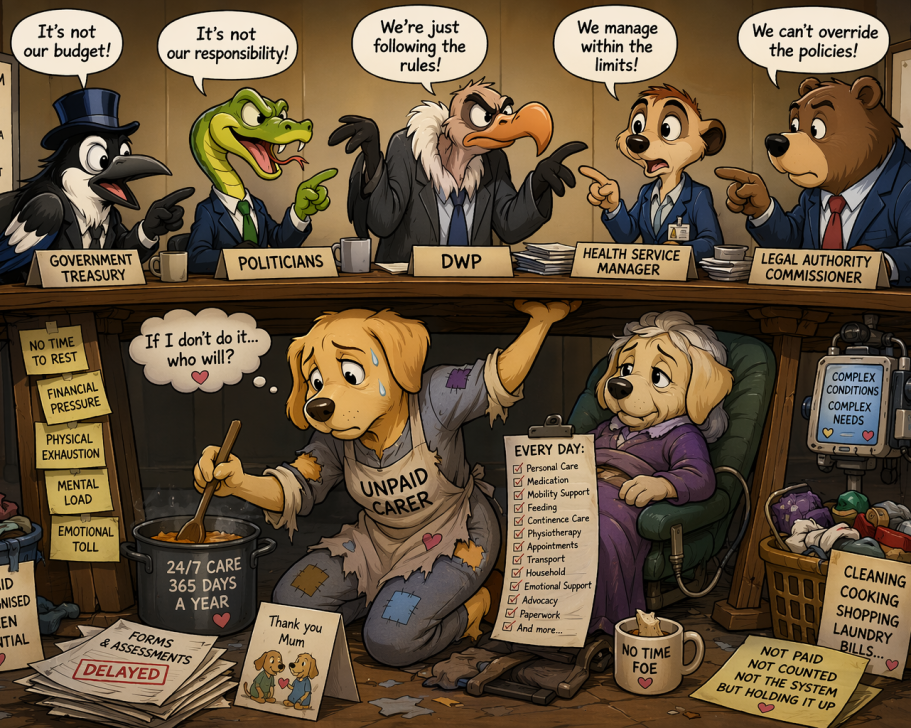
Unpaid Carers, Welfare Reform, and the Quiet Redistribution of Responsibility
A System Under Reconfiguration
From November 2026, proposed changes to Personal Independence Payment (PIP) eligibility are expected to introduce tighter criteria for new claimants. While government framing presents this as improving targeting and system efficiency, the practical implications must be understood in terms of how PIP functions within wider care ecosystems.
Recent reforms sit within a broader policy direction outlined in the government’s welfare reform programme, including the Pathways to Work Green Paper: Read the current Government paper
What PIP Actually Supports (Beyond Income)

Historically, PIP fraud and error rates have been estimated at around 1.4%, with a significant proportion attributed not to deliberate fraud but to administrative delays or failure to update changing conditions. Despite this relatively low proportion, disability benefits represent a substantial area of public expenditure, making them a focal point for cost-saving interventions.
However, PIP is not simply an income stream. For many disabled people, it is a functional enabler of independence. It funds mobility aids, transport, and access to support that is not consistently provided through statutory services.
- A wheelchair enabling independence can cost £1,000+
- Specialist accessible transport is often significantly more expensive than standard travel
- Private continuation of therapy can cost £60+ per week, where NHS provision is limited
When this support becomes harder to access, the gap does not disappear.
It shifts.
The Hidden Transfer of Cost to Unpaid Carers
In practice, that gap is frequently absorbed by unpaid carers.
Carers already operating on Carer’s Allowance of £86.45 per week (approximately £390 per month) are often providing continuous support across every hour of the day, every day of the year.
In this context, reductions in disability support do not reduce need — they redistribute it.
The result is increased pressure on carers to:
- fill mobility gaps
- compensate for reduced therapy access
- provide transport and coordination
- absorb rising private costs where state provision falls short
This creates a structural pressure where carers may feel compelled to privately fund gaps in provision despite existing on extremely limited income.

The Digital Shift in Care and Welfare Systems
Alongside financial reform is a parallel transformation: the digitisation of welfare and care systems.
As services move toward interconnected digital platforms:
- Access becomes portal-based
- communication becomes system-mediated
- updates become automated
- visibility becomes fragmented
While this may improve administrative efficiency, it risks excluding unpaid carers who are not always formally recognised within these systems or consistently granted access to real-time updates.
The result is a growing disconnect between lived care realities and administrative systems.
In this model, unpaid carers risk becoming both:
- The primary source of care
- and one of the least formally integrated actors in the system that governs it
Rethinking Work, Health, and Fit Notes
Recent government trials are also exploring changes to how fit notes are issued and used within employment and healthcare systems.
BBC reporting on pilot schemes highlights proposals to restructure or reduce reliance on traditional GP-issued fit notes in favour of integrated work-focused support pathways: Read the BBC report here
Traditionally, fit notes have not simply confirmed sickness absence. They provide structured clinical guidance on:
- Reduced hours
- phased returns
- altered duties
- workplace adjustments
- safety considerations
This information helps employers meet obligations under health and safety and equality legislation.

When Clinical Guidance Becomes Distributed
The emerging direction being tested in pilot programmes shifts this structure.
In some models:
- GP-issued fit notes are supplemented or replaced
- occupational health and work coaches take a larger role
- return-to-work pathways become more central than certification
The intent is efficiency and faster return-to-work support. However, this changes the structure of responsibility.
If fit notes become less clinically detailed or less central:
- Employers retain legal responsibility for safe working conditions
- but have less structured medical guidance to inform decisions
This creates a system where responsibility remains intact, but clarity becomes more distributed.
Risk Without Clear Anchors
Employers remain legally responsible under:
- Health and Safety at Work Act 1974
- Equality Act 2010 (reasonable adjustments duty)
However, without detailed clinical input, the interpretation of risk becomes more complex:
- functional limitations are harder to assess
- workplace adjustments are less clearly defined
- safety decisions rely more heavily on employer judgement
This does not remove responsibility — it redistributes it.
A Shared Pattern Across Systems
When viewed together, reforms to PIP, digital welfare systems, and fit note processes reveal a consistent pattern.
Support is not simply being reduced.
It is being reconfigured.
Across systems:
- financial support becomes more conditional
- administrative systems become more digital and decentralised
- clinical guidance becomes more distributed across multiple actors
In each case, complexity does not disappear.
It moves.
The Invisible Infrastructure of Care
For unpaid carers, this creates increasing exposure to the gaps between systems:
- financial gaps created by tighter eligibility
- administrative gaps created by digital-first services
- care gaps created when formal support becomes harder to access
In this emerging landscape, unpaid carers are not peripheral to the system.
They are increasingly functioning as its stabilising infrastructure — absorbing the gaps created when formal systems shift toward efficiency, digitisation, and redistributed responsibility.
Closing Reflection: The Shape of What Comes Next
Although the whole system needs an overhaul to work in line with our current society and the way we now live, there is a quieter risk threaded through the direction of change.
When reform begins to treat people as currency, and lives as figures in a chart or a line on a graph, something subtle but significant can happen. A system designed to measure can slowly forget how to see.
There is a danger that we drift toward a tiered version of life itself — where access to support, stability, and dignity is shaped less by need, and more by how well someone fits the systems built around them. Those who can navigate the structure move through it. Those who cannot are left carrying its weight in silence.
And if this continues, we may find ourselves in a future where services are more efficient on paper, but more fragile in reality. Where digital systems hum with coordination, yet feel harder to reach when you are already stretched thin. Where care becomes less visible, not because it is gone, but because it is assumed.
In that future, unpaid carers would not just be supporting individuals within the system — they would be holding together the spaces between its parts. Often unseen. Often unmeasured. Often without pause.
The question is not whether systems will change — they already are.
The question is what kind of shape we allow that change to take, and who it quietly settles upon as it does.